Imm5707 Template
Imm5707 Template
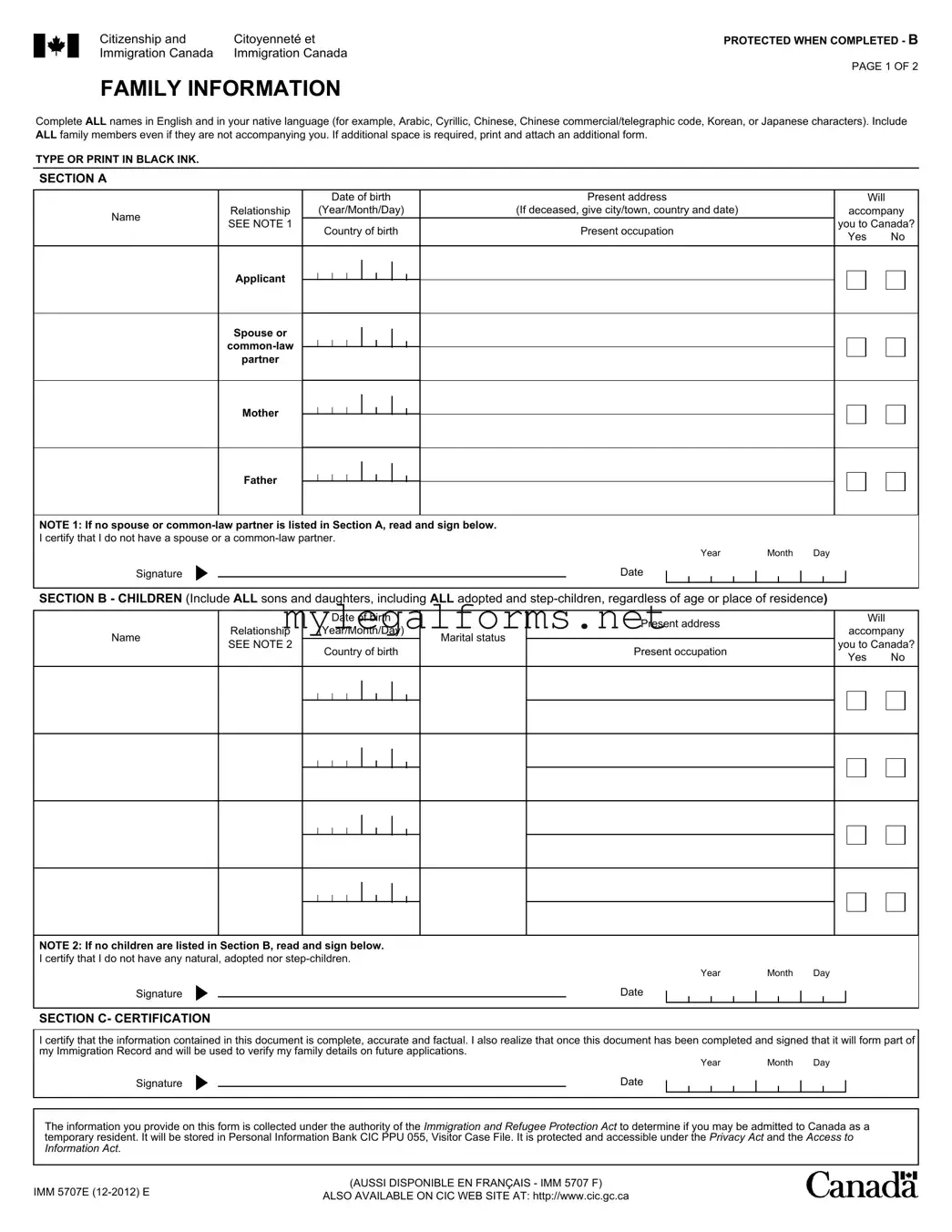
The IMM5707 form is a critical document for individuals seeking temporary residency in Canada. This form, known as the Additional Family Information form, requires applicants to provide detailed information about their family members. It is essential to complete all sections accurately, as the information will be part of the applicant's immigration record. The form is divided into three main sections: personal details of the applicant and their immediate family, information about children, and a certification section where the applicant confirms the accuracy of the information provided. Each family member's name, date of birth, country of birth, and current occupation must be listed, even if they will not accompany the applicant to Canada. If there are no family members to report, the applicant must sign a declaration stating this. The form is designed for individuals over 18 years old and minors traveling alone from specific countries. Completing the IMM5707 is a vital step in the immigration process, ensuring that all relevant family information is documented and verified.
Completing the Imm5707 form accurately is crucial for your immigration process. Here are some key takeaways to keep in mind:
By following these guidelines, you can ensure that your Imm5707 form is completed correctly, helping to facilitate your immigration process.
Da Form 7666 - DA 7666 assists in evaluating personnel competencies and qualifications.
High School Transcript - Can help identify areas of strength and opportunities for improvement.
Spanish Job Application - Employers look favorably on candidates who follow application instructions precisely.
The IMM5707 form, also known as the Additional Family Information form, is essential for individuals applying to enter Canada as temporary residents. Along with this form, several other documents may be required to ensure a complete application. Below is a list of commonly used forms and documents that accompany the IMM5707.
Completing the IMM5707 and its accompanying documents accurately is vital for a successful application. Each form plays a unique role in providing comprehensive information to immigration officials, helping to facilitate the process of entering Canada.
When filling out the Imm5707 form, there are essential dos and don'ts to keep in mind. Adhering to these guidelines can help ensure a smooth application process.
Filling out the Imm5707 form can be a straightforward process, but many individuals make common mistakes that can lead to complications. One prevalent error is failing to include all family members. It is crucial to list every family member, including those who are not accompanying the applicant to Canada. Omitting a spouse, common-law partner, or children can result in delays or even denials of the application.
Another frequent mistake involves incorrect or incomplete information. Applicants often neglect to provide full names in both English and their native language. This is especially important for names that may not easily translate. Ensuring accuracy in spelling and format is essential for processing the application smoothly.
Many applicants also overlook the requirement to indicate the relationship of each family member. This includes specifying whether a child is a biological, adopted, or step-child. Not clarifying these relationships can lead to confusion and may raise questions during the review process.
Additionally, some individuals fail to check the appropriate boxes regarding whether family members will accompany them to Canada. This simple oversight can create misunderstandings and complicate the immigration process. It is advisable to double-check these details before submitting the form.
Another common error is neglecting to sign and date the form in the designated areas. A missing signature can result in the application being returned, causing unnecessary delays. It is vital to ensure that all required signatures are present.
Many applicants also make the mistake of not reading the notes provided in the form. For example, if there is no spouse or common-law partner, applicants must sign a declaration stating this. Ignoring such instructions can lead to incomplete applications.
Finally, some people forget to provide information about deceased family members. If a family member has passed away, it is necessary to indicate their date of death and last known address. This information is essential for creating an accurate immigration record.
| Fact Name | Details |
|---|---|
| Purpose | The IMM5707 form collects family information for individuals applying to enter Canada as temporary residents. |
| Who Should Complete It | This form must be filled out by each individual aged 18 or older or by minors traveling alone from specific countries. |
| Included Family Members | All family members must be listed, including spouses, common-law partners, children, and even those not accompanying the applicant. |
| Certification Requirement | Applicants must certify that the information provided is complete and accurate. This is crucial for the integrity of the immigration process. |
| Legal Authority | The information is collected under the Immigration and Refugee Protection Act, ensuring compliance with Canadian immigration laws. |
| Privacy Protection | Data collected is protected under the Privacy Act and the Access to Information Act, ensuring confidentiality and security. |