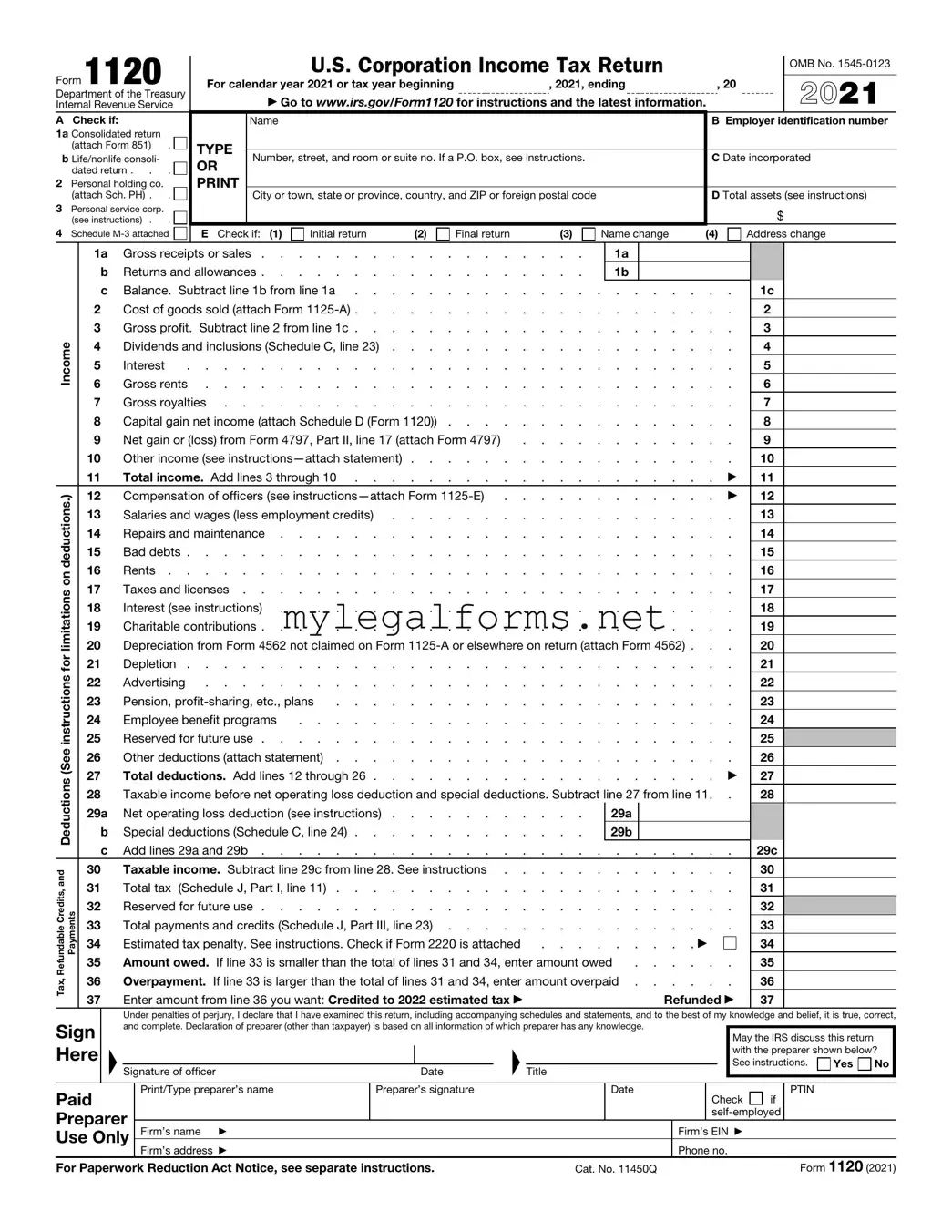
IRS 1120 Template
IRS 1120 Template
The IRS 1120 form is a crucial document for corporations operating in the United States, serving as the primary tax return for C corporations. This form provides a comprehensive overview of a corporation's income, deductions, and tax liability for the fiscal year. When completing the 1120, corporations must report their total revenue, which includes sales, dividends, and interest, while also detailing various expenses that can be deducted, such as operating costs, salaries, and depreciation. Additionally, the form requires corporations to disclose their tax credits and any applicable taxes owed. By accurately filling out the 1120, corporations ensure compliance with federal tax regulations, which can help avoid penalties and interest charges. Understanding the nuances of this form is essential for business owners and financial professionals alike, as it not only impacts the corporation's financial standing but also influences strategic decisions for future growth.
Filling out the IRS 1120 form can seem daunting, but it’s essential for corporations to report their income, gains, losses, deductions, and credits. Here are some key takeaways to keep in mind:
Free Printable Dl-43 Form - The DL-43 can help streamline the document submission process for license updates.
Farbar Forms - Tax responsibilities and adjustments for the property are also specified, promoting transparency in financial obligations.
Preparing for marriage involves important decisions, and utilizing a strategic Prenuptial Agreement can help outline financial expectations and responsibilities, providing clarity for both partners. This proactive approach ensures that you are both on the same page as you embark on this new journey together.
Employee Advance Agreement - Make your immediate financial needs a priority with this advance.
When filing your corporate taxes, the IRS Form 1120 is just one piece of the puzzle. There are several other forms and documents that you may need to complete your filing accurately. Each of these forms serves a specific purpose and helps ensure compliance with tax regulations. Here’s a list of commonly used documents that often accompany the IRS Form 1120.
Understanding these additional forms can help streamline your tax filing process and ensure that you meet all necessary requirements. Always consider consulting with a tax professional to navigate these forms effectively and avoid any pitfalls.
When completing the IRS 1120 form, it is important to follow certain guidelines to ensure accuracy and compliance. Here are some dos and don'ts to consider:
Filling out the IRS Form 1120 can be a daunting task for many business owners. One common mistake is failing to accurately report income. It's essential to include all sources of revenue, whether from sales, services, or other business activities. Omitting any income can lead to discrepancies and may trigger an audit. Being thorough and meticulous is crucial in this process.
Another frequent error involves misclassifying expenses. Business expenses must be categorized correctly to ensure compliance with tax laws. For instance, personal expenses mistakenly labeled as business expenses can create significant issues. Keeping detailed records and receipts can help avoid this pitfall.
Many individuals also overlook the importance of signing the form. It may seem like a minor detail, but an unsigned Form 1120 is considered incomplete. This oversight can delay processing and lead to penalties. Always double-check that all required signatures are in place before submitting the form.
Additionally, some taxpayers fail to file on time. The IRS imposes strict deadlines for submitting Form 1120. Missing these deadlines can result in penalties and interest on unpaid taxes. Setting reminders and preparing the form in advance can help ensure timely filing.
Lastly, errors in calculations are another common mistake. Simple math errors can lead to incorrect tax liabilities, which can complicate future filings. It is advisable to review calculations carefully or consider using tax software to minimize these mistakes. Taking the time to verify all figures can save headaches down the line.
| Fact Name | Description |
|---|---|
| Purpose | The IRS Form 1120 is used by corporations to report their income, gains, losses, deductions, and credits, as well as to calculate their federal income tax liability. |
| Filing Requirement | Corporations must file Form 1120 annually, regardless of whether they have taxable income. |
| Due Date | The due date for filing Form 1120 is the 15th day of the fourth month after the end of the corporation's tax year. |
| Tax Rates | Corporations are subject to a flat tax rate of 21% on their taxable income as of the Tax Cuts and Jobs Act of 2017. |
| Estimated Payments | Corporations may be required to make estimated tax payments throughout the year if they expect to owe tax of $500 or more. |
| State-Specific Forms | Many states require a separate corporate tax return. For example, California requires Form 100 under California Revenue and Taxation Code Section 23101. |
| Electronic Filing | Corporations can file Form 1120 electronically, which may expedite processing and reduce errors. |
| Extensions | Corporations can request a six-month extension to file Form 1120 by submitting Form 7004, but any taxes owed must still be paid by the original due date. |
| Amendments | If a corporation needs to correct errors on a previously filed Form 1120, it must file Form 1120X to amend the return. |
| Record Keeping | Corporations should maintain copies of their filed Form 1120 and supporting documents for at least three years from the due date of the return. |