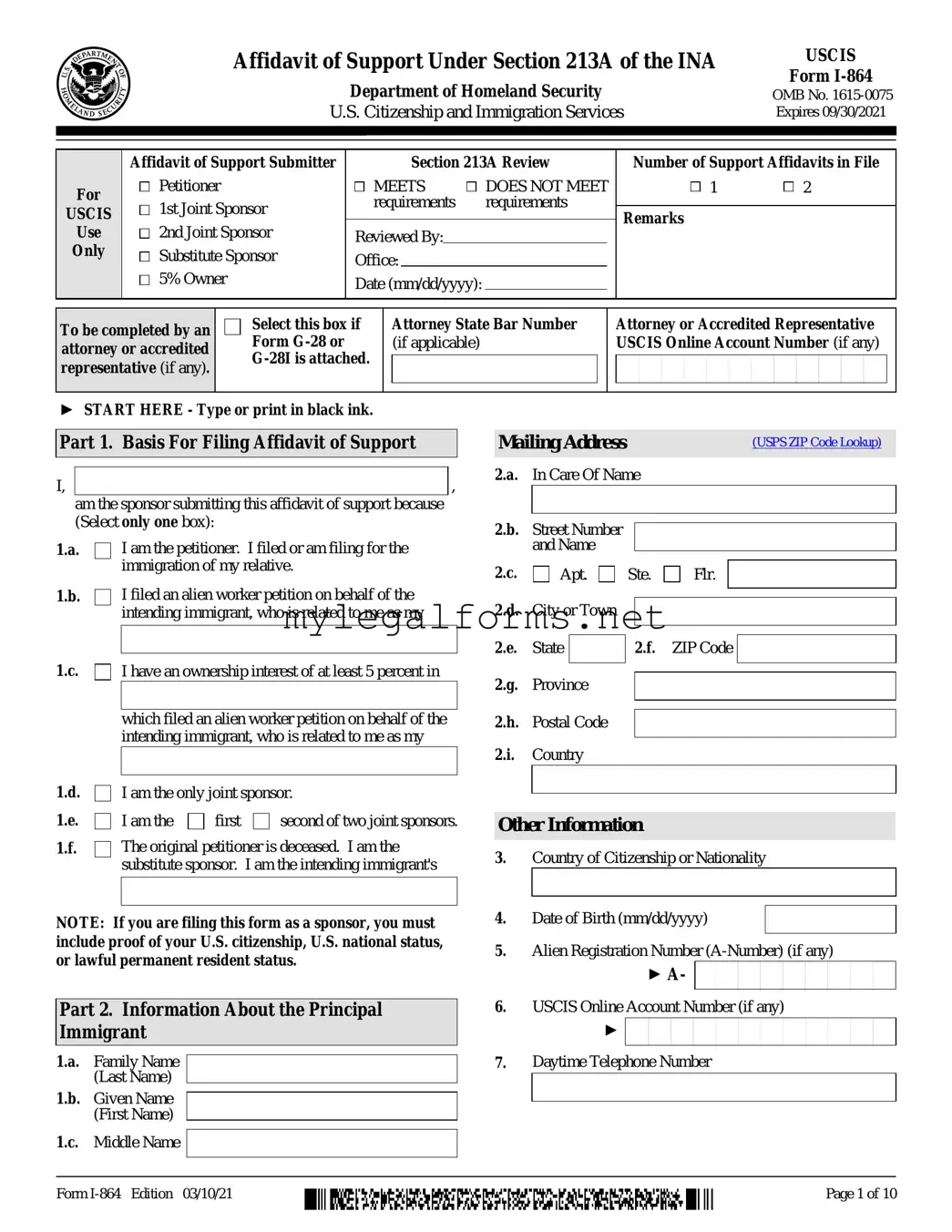
USCIS I-864 Template
USCIS I-864 Template
The USCIS I-864 form, also known as the Affidavit of Support, plays a crucial role in the immigration process for individuals seeking to bring family members to the United States. This form serves as a binding contract between the sponsor, typically a U.S. citizen or lawful permanent resident, and the U.S. government, ensuring that the sponsored immigrant will not become a public charge. By completing the I-864, the sponsor commits to financially supporting the immigrant, demonstrating the ability to meet income requirements based on the federal poverty guidelines. This form requires detailed information about the sponsor's income, assets, and household size, and it must be accompanied by supporting documentation such as tax returns and pay stubs. Importantly, the I-864 is not just a formality; it carries significant legal weight, as failure to fulfill the obligations outlined in the affidavit can lead to serious consequences for the sponsor. Understanding the intricacies of the I-864 is essential for anyone involved in the family-based immigration process, as it directly impacts the immigrant's ability to secure a green card and build a life in the United States.
The USCIS I-864 form, also known as the Affidavit of Support, is an important document for immigrants seeking permanent residency in the United States. Here are some key takeaways to keep in mind when filling out and using this form:
Understanding these key points can help ensure a smoother process when navigating the immigration journey. Always consider consulting with a professional if you have questions or need assistance.
Ccorp - Some businesses may find switching to an S corporation advantageous by using Form 2553.
Usps Form 3575 Pdf - Utilize this form to ensure timely receipt of important documents.
The USCIS I-864 form, also known as the Affidavit of Support, is a critical document for immigrants seeking permanent residency in the United States. It demonstrates that a sponsor has the financial means to support the immigrant and prevent them from becoming a public charge. Alongside the I-864, several other forms and documents may be required to complete the application process. Here are five common ones:
Gathering these documents can seem overwhelming, but each plays a vital role in the immigration process. Ensure that all forms are completed accurately and submitted on time to avoid delays in your application.
When filling out the USCIS I-864 form, it's important to follow certain guidelines to ensure your application is processed smoothly. Here are some dos and don'ts to keep in mind:
Filling out the USCIS I-864 form can be a complex process, and many individuals make mistakes that can delay their application. One common error is failing to provide accurate income information. Applicants often underestimate or overestimate their income, which can lead to complications in demonstrating financial support. It is essential to provide precise figures from the most recent tax returns or pay stubs.
Another frequent mistake involves neglecting to include all necessary household members. Many applicants forget to list all individuals who are part of their household, which can affect the calculation of household income. This oversight can result in a lack of clarity regarding financial resources available to support the intending immigrant.
Additionally, some applicants do not sign the form. A signature is a critical component of the I-864, as it signifies that the information provided is true and complete. Without a signature, the application may be considered incomplete and could be rejected by USCIS.
Providing outdated financial documents is another error that can hinder the application process. It is crucial to submit current tax returns, W-2 forms, and other relevant financial documents. Using outdated information can raise questions about the applicant's current financial situation.
Lastly, many individuals fail to read the instructions carefully. Each section of the I-864 has specific requirements, and misunderstanding these can lead to incomplete or incorrect submissions. Taking the time to read and follow the instructions can significantly improve the chances of a successful application.
| Fact Name | Details |
|---|---|
| Purpose | The I-864 form is used to demonstrate that an immigrant has adequate financial support from a sponsor. |
| Who Must File | U.S. citizens and lawful permanent residents who are sponsoring an immigrant must file this form. |
| Income Requirement | The sponsor's income must be at least 125% of the Federal Poverty Guidelines for their household size. |
| Supporting Documents | Along with the I-864, sponsors must provide proof of income, such as tax returns and pay stubs. |
| Joint Sponsors | If the primary sponsor does not meet the income requirement, a joint sponsor can submit a separate I-864 form. |
| Legal Obligations | Sponsors are legally obligated to support the immigrant financially until they become a U.S. citizen or can be credited with 40 quarters of work. |
| Filing Location | The I-864 form is submitted to USCIS as part of the immigrant visa application process. |
| State-Specific Laws | Each state may have additional requirements or considerations, but the I-864 is governed by federal law under the Immigration and Nationality Act. |